

Why Does My Child Fall Apart After School?

Understanding Overwhelm, Shutdown, and the Nervous System Behind Back-to-School Stress
They Held It Together All Day. Then They Got Home.
It’s a few weeks into the school year. The new backpacks aren’t quite so new anymore, routines have started settling in, homework is picking up, sports are in full swing, and the excitement of going back to school has been replaced by everyday life.
And this is often when parents begin noticing something.
Your child’s teacher says they’re doing great. They’re following directions, participating in class, keeping up academically, and getting along with their friends. Then they walk through your front door and seem like a completely different child.
Maybe they melt down over something that normally wouldn’t bother them. They snap at their siblings, argue about homework, cry because their socks feel wrong, or completely lose it when you ask what they want for dinner. Another child may do the opposite. They disappear into their room, lie on the couch, stare at a screen, stop talking, or seem completely exhausted by the simplest request.
Parents understandably wonder, “If they can hold it together all day at school, why do they fall apart the minute they get home?”
The answer may have much less to do with behavior than we realize.
Your child may have successfully made it through the school day, but their nervous system may be telling an entirely different story.
School Requires More From the Nervous System Than Academics
When we think about the demands of school, we tend to think about reading, writing, math, tests, and homework. But neurologically, a child is doing far more than learning.
From the moment they wake up, their nervous system is processing demands. They have to transition from sleep to getting ready, get out the door on time, navigate transportation, enter a busy building, process lights and sounds, sit when they are expected to sit, move when they are expected to move, listen to instructions, filter distractions, interact socially, interpret facial expressions, regulate emotions, transition between subjects, remember information, make decisions, eat within a schedule, navigate recess and lunch, and then do it all again the next day.
For many children, sports, practices, lessons, homework, and evening activities begin almost immediately afterward.
None of these things are inherently bad. Learning, relationships, movement, challenge, and even appropriate stress are important parts of development. The question is whether a child’s nervous system has enough capacity to meet those demands and still have something left in reserve.
That is where overwhelm begins to make more sense.
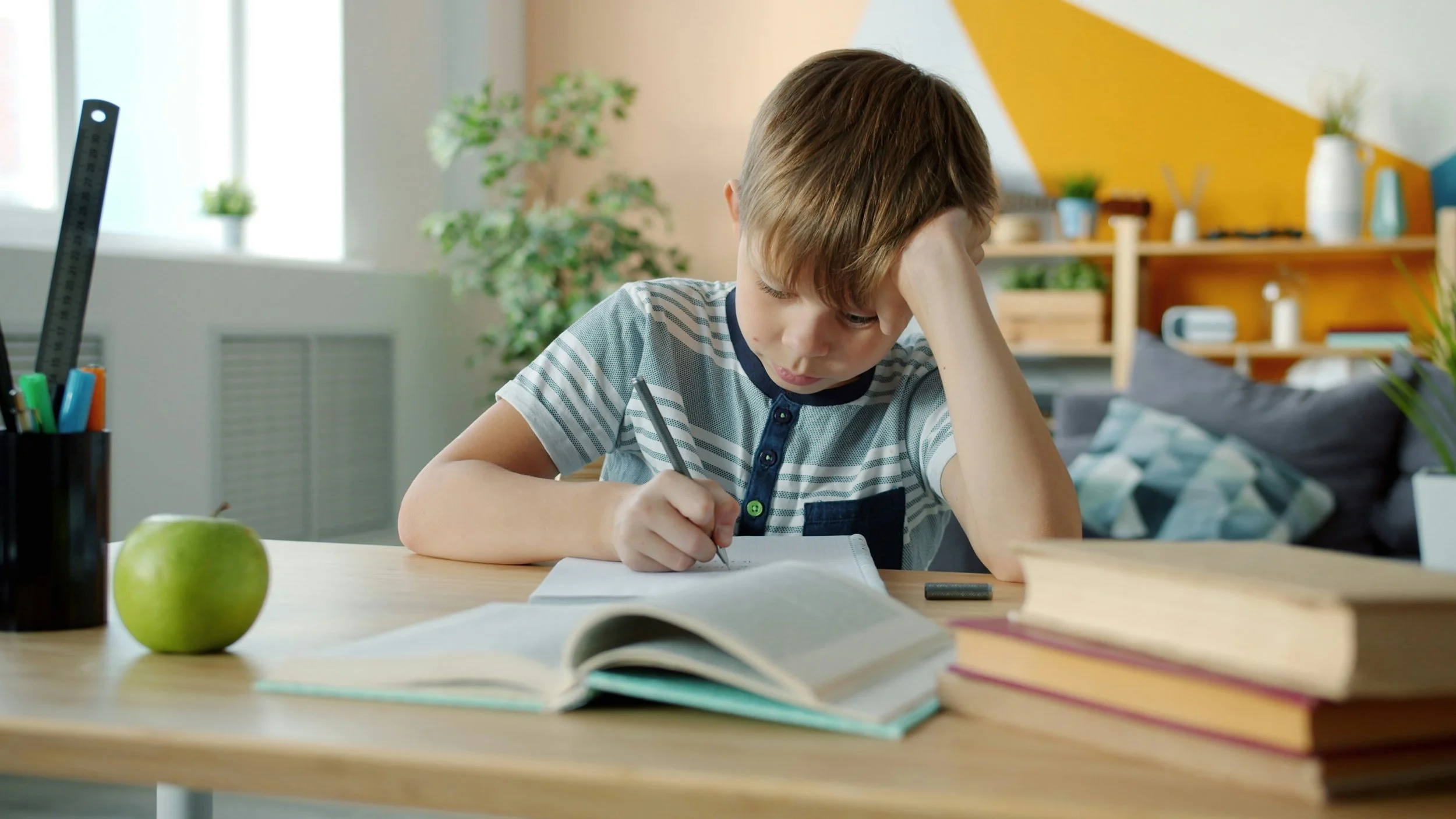
Every Child Has a Neurological Budget
Think about your child’s nervous system as having a neurological budget.
Every day, the brain and body have a certain amount of capacity available to respond to life. That capacity is being used for far more than school. The nervous system is simultaneously coordinating movement, sensory processing, emotional regulation, digestion, immune activity, growth, repair, learning, social connection, and recovery.
Then we add the demands of the environment.
A noisy classroom requires something from that budget. So does concentrating on an assignment, sitting still when the body wants to move, navigating a difficult friendship, processing fluorescent lights, changing classrooms, remembering instructions, practicing after school, completing homework, and getting to bed on time.
A child with plenty of neurological reserve may move through those demands and still have capacity left.
Another child may spend nearly everything they have just getting through the day.
This is why two children can experience the exact same school, classroom, teacher, family, or schedule and respond completely differently. The stressor is only part of the equation. The nervous system’s capacity to adapt to that stressor matters just as much.
Overwhelm Doesn’t Look the Same in Every Child
When a nervous system begins running out of capacity, the brain has to make decisions about what matters most.
Some children move toward a more obvious fight-or-flight response. They become louder, busier, more impulsive, argumentative, emotional, restless, or explosive. Their bodies are telling you very clearly that they have reached their limit.
Other children move toward shutdown.
They become quiet, withdrawn, exhausted, disconnected, unmotivated, or unable to communicate what is wrong. They may want to sleep, stare at a screen, hide in their room, or simply be left alone.
And some children move between both.
They may hold everything together beautifully at school and then explode in the safety of their own home. After the meltdown, they may completely crash.
This is an important distinction because a quiet nervous system is not necessarily a regulated nervous system.
A child who has shut down may look calm from the outside while their nervous system is just as overwhelmed as the child having the meltdown.
Instead of asking only, “Why is my child behaving this way?” it can be much more helpful to ask, “What did their nervous system have to do to get through today?”

Home May Be Where Their Nervous System Finally Lets Go
There is another reason the after-school hours can be especially revealing.
Home is often where children feel safest.
At school, they may be using enormous amounts of neurological energy to follow expectations, manage sensory input, interact appropriately, complete their work, and keep themselves organized. They are doing what their nervous system believes it needs to do to successfully navigate that environment.
Then they get home.
The demand changes. The environment feels familiar. The people feel safe. And the nervous system finally stops holding everything together.
That doesn’t mean parents should simply accept every behavior that happens after school, and it doesn’t mean expectations or boundaries disappear. But understanding what may be happening underneath the behavior gives us a much better starting point for helping the child.
Sometimes what looks like defiance is depletion.
Sometimes what looks like laziness is shutdown.
Sometimes what looks like an overreaction is the final demand placed on a nervous system that had almost nothing left to give.
What About the Child Who Seems Completely Fine?
This is where the conversation becomes even more interesting.
In many families, one child gets most of the attention because they are visibly struggling. Maybe they have sensory challenges, ADHD, anxiety, sleep difficulties, behavioral concerns, headaches, stomachaches, or difficulty at school.
Their sibling seems fine.
But “not struggling” and “adapting well” are not necessarily the same thing.
Some nervous systems communicate stress loudly. Others compensate quietly.
One child may melt down after school while their sibling gets straight to homework but lies awake for an hour every night. One may complain about stomachaches while another becomes incredibly rigid about their routine. One may become emotional while another simply becomes quieter. And sometimes a child truly is adapting beautifully.
The point isn’t to assume every child has a problem.
It is to become curious about how each child is adapting.
Children can grow up in the same home, attend the same school, eat the same meals, experience the same family changes, and participate in many of the same activities while having completely different neurological responses to those experiences.
That is because we do not experience stress based solely on what happens around us. We experience it through the nervous system that has to interpret and respond to it.

We Don’t Want to Remove Every Stressor
The answer to overwhelm isn’t creating a life where nothing challenges our children.
Children need challenge.
They need opportunities to learn, stretch, fail, recover, solve problems, build relationships, move their bodies, and experience new things. Appropriate stress is part of how resilience develops.
The goal is not to continually make the environment smaller so the child never becomes uncomfortable.
The goal is to increase the nervous system’s capacity so the child can experience more of life without constantly being pushed beyond what their system can handle.
That distinction matters.
Because if a nervous system has very little reserve, even ordinary childhood can begin feeling overwhelming. School, sports, birthday parties, family gatherings, homework, vacations, changes in routine, and relationships can all become another withdrawal from an already depleted neurological budget.
When capacity increases, the environment doesn’t necessarily have to change.
The child’s ability to experience it can.
This Is Why We Look at the Nervous System
When a child comes into our office, we are not simply asking whether they have symptoms.
We want to understand how well their nervous system is adapting.
We look at their history, including pregnancy, birth, development, illness, injuries, sleep, digestion, sensory processing, movement, emotional regulation, and the demands being placed on them today. We also use neurological scans to measure patterns of stress and regulation that cannot always be seen simply by watching a child.
This gives us a very different picture.
We are not trying to diagnose the meltdown, treat the homework battle, or make a quiet child more outgoing. We are looking for patterns of neurological stress that may be causing the brain and body to work harder than they should.
Nervous system-focused chiropractic care then gives us a way to begin changing those patterns. Through specific adjustments and repetition over an appropriate care plan, we provide new neurological input that helps improve communication between the brain and body. Over time, the goal is greater regulation, greater adaptability, and more reserve for everything else that child is being asked to do.
We aren’t trying to remove school, sports, siblings, homework, or every stressor from a child’s life.
We are trying to help their nervous system become more capable of meeting life.
September Gives Us a Unique Opportunity to Look
Back-to-school season gives parents a fascinating window into their children.
The environment just changed.
The demands increased.
And now we get to watch how each nervous system responds.
For some children, the transition is seamless. For others, the signs are obvious. And for some, the clues are much quieter.
That is why throughout September, we are offering complimentary nervous system scans for siblings of our current patients.
This isn’t because we assume something is wrong with your other children. Quite the opposite. We are incredibly grateful that your family trusts us with your care, and we want to give you an opportunity to take a peek under the hood and see how your other children are adapting, too.
They are experiencing many of the same family rhythms, school demands, activities, and everyday stressors as their sibling, but their nervous systems may be responding very differently.
The scans give us an opportunity to look before you have to guess.
If everything looks great, that is wonderful information to have. If we see a nervous system working harder than expected, we can have a conversation about what that means and whether anything needs to be done.
Because we don’t believe parents should have to wait until a child is falling apart before becoming curious about how well they are adapting.
If you are a current Purpose Driven Chiropractic family and have another child you would like us to scan, talk with our team about scheduling their complimentary sibling scans during September.
And if you know another parent whose child seems to fall apart the moment they get home from school, send them this article. Sometimes understanding that the behavior may be telling a nervous system story changes the entire conversation.
