

Why Airway Issues Are About More Than Breathing

Cranial Development, Nervous System Stress, and the Bigger Story Behind Mouth Breathing
The Airway Conversation Is Everywhere Right Now
Parents are hearing more about airway health than ever before, and for good reason.
Maybe your child sleeps with their mouth open, snores, grinds their teeth, drools on the pillow, seems chronically congested, or wakes up tired after what should have been a full night of sleep. Maybe you’ve been told they have enlarged tonsils or adenoids, a high narrow palate, crowded teeth, or a jaw that doesn’t seem to have enough room.
Other signs can show up far from the mouth. Restless sleep. Trouble focusing. Big emotional swings. Headaches. Frequent cavities. Daytime fatigue. Behavior that looks “wired but tired.”
And suddenly, a parent who thought they were dealing with sleep or teeth is hearing words like airway, myofunctional therapy, palate expansion, tongue posture, orthodontics, and mouth breathing.
Those conversations matter.
But there’s a piece that often gets missed when we rush too quickly toward creating more space.
The airway doesn’t develop by itself.
The palate doesn’t develop by itself.
The jaw doesn’t develop by itself.
They develop inside a growing, adapting system — one that is constantly responding to breathing, feeding, posture, muscle tone, stress, and the brain’s ongoing regulation of the body.
That bigger picture matters.
Mouth Breathing Is a Clue, Not the Whole Story
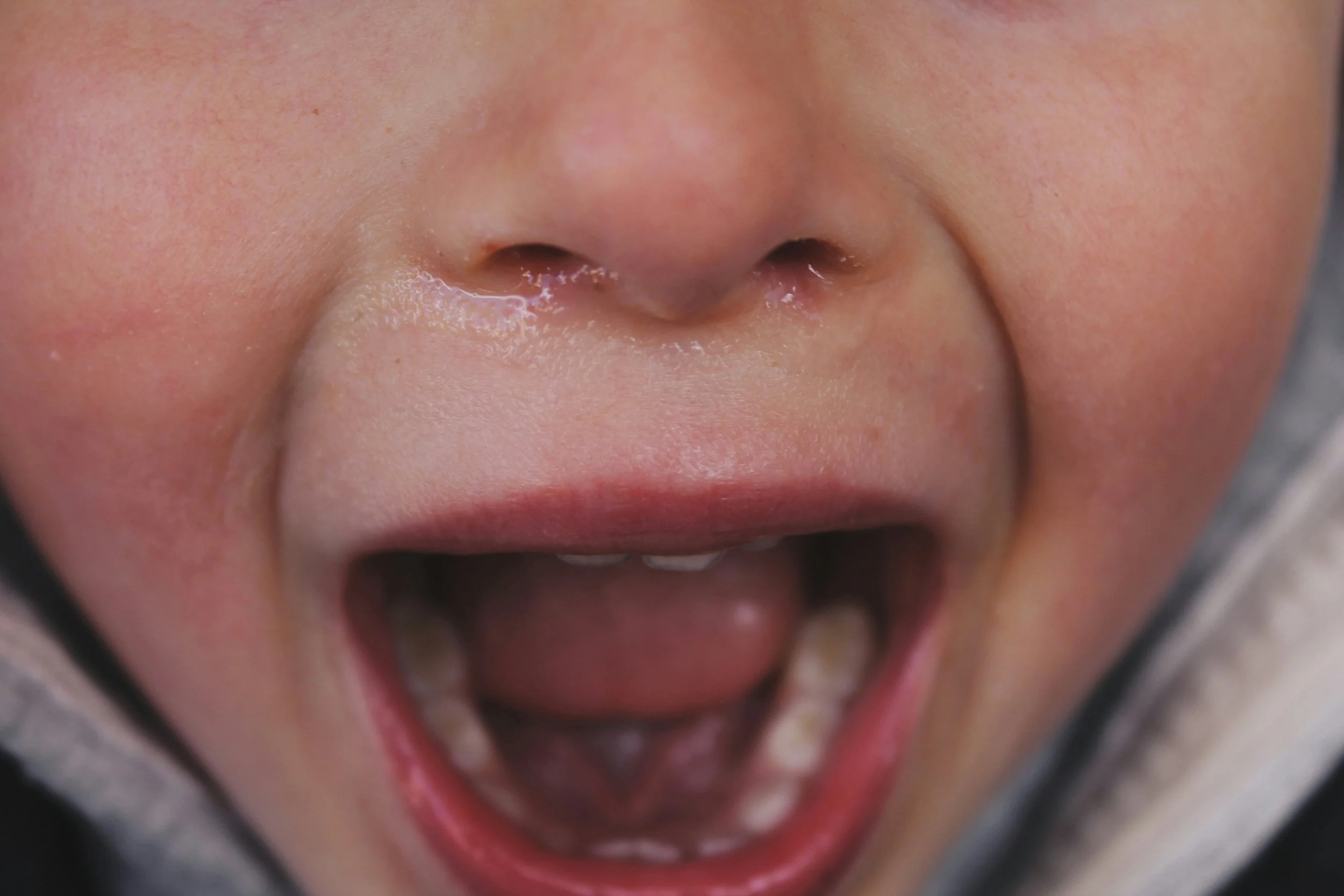
Mouth breathing deserves attention because chronic nasal obstruction and sleep-disordered breathing in children can affect far more than sleep. Pediatric airway research consistently links it with changes in growth, behavior, learning, and daytime function.
But mouth breathing is often not the root problem.
It is frequently a compensation.
The body may be adapting to nasal obstruction, enlarged tonsils or adenoids, tongue posture limitations, craniofacial structure, or a combination of factors. Once that compensation becomes the “new normal,” the rest of the system reorganizes around it.
Head posture shifts.
Neck muscles work differently.
Tongue posture changes.
Breathing patterns adapt.
Facial growth follows the function it is given.
Over time, those adaptations can become visible in structure.
This is why research continues to show associations between chronic mouth breathing and patterns like narrow maxilla, high-arched palate, altered facial growth, and malocclusion.
The key word is association.
So instead of asking, “What caused this shape?”
A better question is:
“What has this child been adapting to for so long?”
Structure Is a Record of Function
We often look at anatomy as if it simply “appeared.”
But in children, structure is still under construction.
The skull, face, jaw, and palate are actively developing in response to function — especially breathing, swallowing, feeding, posture, and movement.
The cranial sutures are not static seams in childhood. They are growth interfaces that allow the skull to expand and remodel as the brain grows rapidly.
So when we see:
a high palate
a narrow upper jaw
facial asymmetry
jaw imbalance
flattened or uneven cranial shape
we’re not just looking at “structure.”
We’re looking at a history of function and adaptation.
And that shifts the questions we ask:
How has this child been breathing?
How have they been feeding?
Where does the tongue rest when they are not thinking about it?
How has their sleep been?
How has their body organized around stress or tension?
What patterns started early and never fully resolved?
Those answers matter more than measurements alone.
The Cranium Is Not a Fixed Helmet
The skull is often imagined as a rigid protective shell.
In reality, in a growing child, it is a dynamic system.
The bones of the skull are connected by sutures that allow growth and subtle movement. These structures respond to internal and external forces — breathing, swallowing, posture, muscle tension, and developmental growth patterns.
We do need to be careful here.
Some explanations in the wellness world overstate cranial motion or suggest exaggerated mechanical models of how the skull behaves. Those claims are not strongly supported in mainstream anatomy or physiology.
But we don’t need exaggeration to understand something important:
the skull is not fully fused in childhood
growth happens at the sutures
breathing and circulation create real pressure changes in the head and body
asymmetrical forces over time can influence shape
In other words, the cranium is responsive — especially during development.
That’s what makes it clinically meaningful to evaluate.
Not because it is “moving dramatically,” but because it is developing under the influence of everything the child is doing and experiencing.

Why Fluid and Pressure Still Matter (Without Overcomplicating It)
Inside and around the brain is cerebrospinal fluid (CSF), which helps cushion the nervous system and supports metabolic exchange and waste clearance.
CSF is not static. It moves in response to normal physiological rhythms — including breathing and cardiovascular activity.
So when we talk about breathing, posture, and cranial development, we are really talking about systems that are already connected:
respiration influences pressure
circulation influences fluid movement
posture influences both
the nervous system regulates all of it
We are not trying to “manipulate fluid dynamics.”
We are recognizing that the body is already a continuous, interconnected system, and development reflects that interaction over time.
Birth Is Often the First Big Pattern
If we zoom all the way back, development doesn’t start at symptoms — it starts at birth.
The infant skull is designed to mold during delivery. That’s normal and necessary.
But the forces involved in birth are not always gentle or symmetrical.
Long labors, very fast deliveries, persistent positioning, vacuum or forceps assistance, or difficult transitions can all place mechanical and neurological stress through the head, neck, and upper body.
This does not mean anything is “wrong” with those births.
It simply means:
birth is part of the developmental story.
And when we see patterns like feeding difficulty, head preference, tension, asymmetry, or later airway concerns, it is worth asking whether early mechanical and neurological stress played a role in how the system organized itself.
Because development is cumulative.
The Tongue: Small Structure, Big Influence
The tongue is one of the most important players in airway development.
When it rests properly against the palate, it helps guide normal growth of the upper jaw and supports nasal breathing patterns.
When it does not function well — due to restriction, low tone, poor coordination, or compensatory patterns — the system adapts.
That adaptation can influence:
palate shape
jaw development
breathing patterns
swallowing mechanics
facial growth
This is why a tongue tie is not just about appearance.
The real question is always:
Can the tongue function the way it needs to for this child’s development?
Sometimes a release is appropriate. Sometimes it is not. But structure alone is never the full answer — function has to be part of the decision.

Why We Don’t Jump Straight to Expansion or Braces
We are not anti-expansion.
We are not anti-orthodontics.
These tools can be extremely helpful when used at the right time, for the right child, with the right context.
The concern is when we treat the palate or teeth as isolated structures that can be “fixed” without understanding the system they belong to.
Because the palate is not separate from:
breathing
tongue function
jaw mechanics
cranial development
nervous system regulation
upper neck tension
If those systems are still in a compensatory pattern, simply creating more space may not resolve why the pattern developed in the first place.
You can change structure without changing function.
And when that happens, the body often finds a new way to compensate.
That’s why we emphasize:
function first, force second — whenever possible.
The Nervous System Is the Organizer
At the center of all of this is the nervous system.
It is constantly interpreting input from the body and deciding:
what is safe
what needs protection
what needs tension
what can relax
how the body should organize itself
When stress becomes chronic — whether from breathing issues, developmental strain, birth history, or ongoing compensation — the nervous system can shift into a protective pattern.
And protective patterns change everything:
posture
muscle tone
breathing mechanics
sleep quality
movement efficiency
facial and jaw development
Over time, the body begins to reflect the pattern it is living in.
So our focus is not forcing change.
It is helping the nervous system update the way it is organizing the body.
When that happens, the system becomes more adaptable — and development has a better chance to normalize.
Why Timing Still Matters
Childhood is a window of rapid development.
The face, jaw, airway, and nervous system are still being shaped by function and growth. That means early recognition matters.
There is no single age when development suddenly “locks in.”
It is gradual, individual, and highly responsive to function over time.
The earlier we identify patterns, the more opportunity we have to support:
nasal breathing
tongue function
sleep quality
cranial development
nervous system regulation
before compensation becomes deeply established.
What We Usually Recommend
When we see significant patterns of compensation, we start by addressing the foundation.
That means supporting nervous system regulation first — helping the body move out of chronic protective patterns and into better adaptability.
From there, the next steps become clearer and more individualized.
That may include:
airway-focused dental or orthodontic evaluation
myofunctional therapy
ENT assessment
palate expansion when appropriate
tongue-tie evaluation or release when function indicates
Often, it is not one provider or one intervention.
It is a coordinated approach to a developing system.
And that is exactly how it should be.

The Bigger Airway Conversation
The rise in awareness around pediatric airway health is a good thing.
Parents should notice mouth breathing.
They should notice snoring.
They should ask questions about sleep, behavior, growth, and development.
But we have to be careful not to turn airway care into a one-size-fits-all structural fix.
Because the airway is not just a passage for air.
It is part of a living, developing system that reflects:
function
movement
regulation
growth
adaptation
And when we understand that, the conversation becomes much bigger than breathing.
It becomes about how a child is developing as a whole.
And that is the story worth paying attention to.
Wondering What Your Child’s Airway Is Telling You?
If your child is mouth breathing, snoring, grinding their teeth, struggling with restless sleep, developing a high or narrow palate, experiencing crowded teeth, or being recommended for a palate expander, braces, or tongue-tie revision, there may be more to the story.
Before focusing only on changing the structure, we believe it is worth understanding why the structure developed the way it did in the first place.
At Purpose Driven Chiropractic, we evaluate the nervous system, developmental history, cranial and body tension patterns, and the way your child is adapting as a whole. From there, we can help determine whether nervous system-focused chiropractic care should be part of the foundation and when it may be appropriate to bring in myofunctional therapy, airway-focused dentistry or orthodontics, ENT evaluation, or other providers.
If you have questions about your child’s breathing, sleep, cranial development, or nervous system, schedule a neurological evaluation with our team. Let’s look beyond the airway and understand the whole child.
And if you know another parent who is currently navigating mouth breathing, sleep concerns, palate expansion, braces, or a tongue-tie decision, send them this article. These decisions are much easier to navigate when parents understand the bigger picture before deciding what comes next.
