

The Reflexes Your Baby Was Supposed to Outgrow: What Primitive Reflexes Tell Us About Brain Development
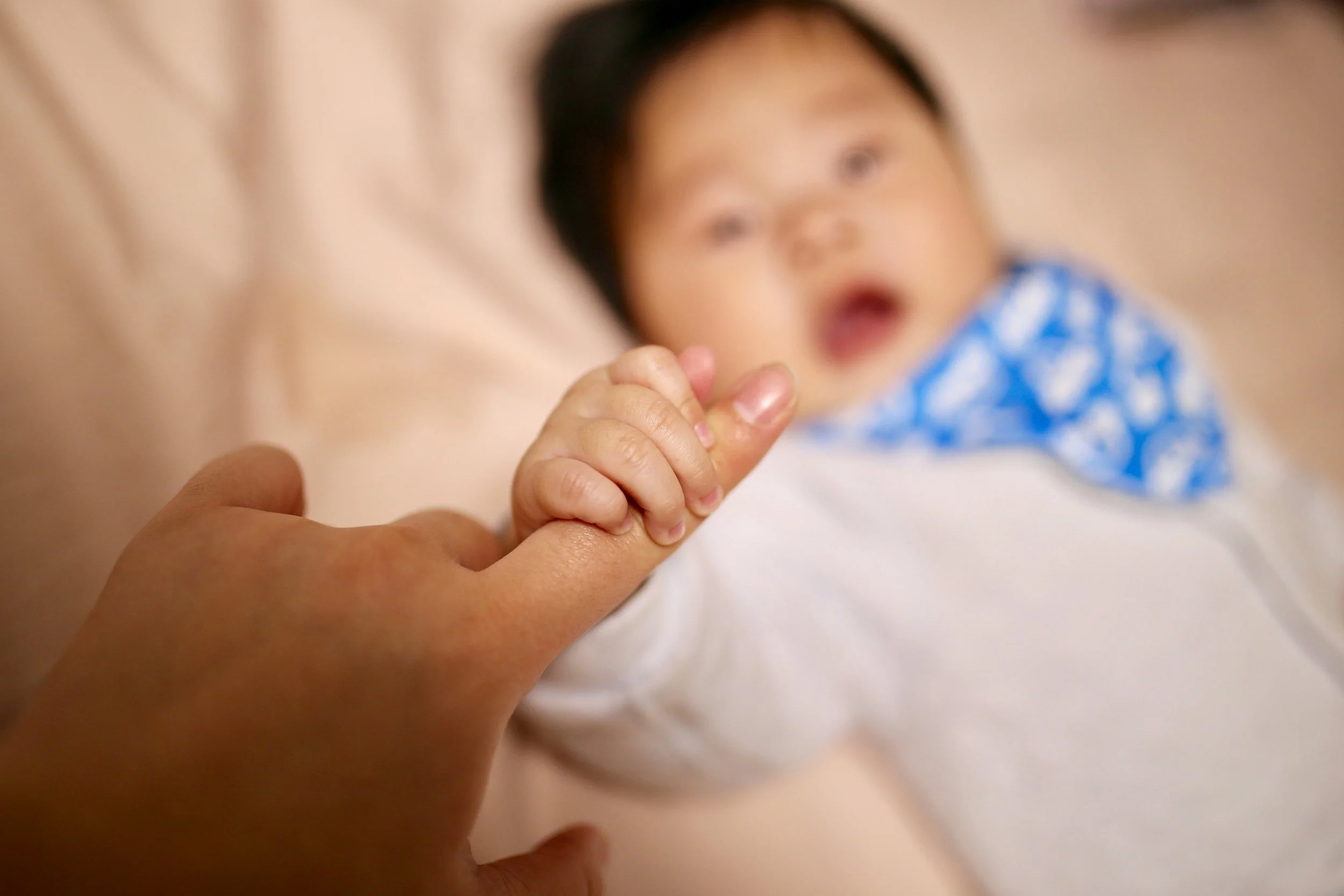
Have you ever watched a newborn suddenly throw both arms out when they hear a loud noise, or placed your finger into a baby’s palm and felt those tiny fingers immediately wrap around it? Maybe you have watched a baby turn their head toward a touch on the cheek, searching instinctively for something to suck.
No one taught them how to do any of this. They were born knowing.
These automatic movements are called primitive reflexes, and they are some of the earliest evidence we have that the nervous system is already hard at work long before a child can voluntarily control their body.
Primitive reflexes are involuntary movement patterns primarily organized through the brainstem and spinal cord. They begin developing during pregnancy and are present for very good reasons. They help a newborn feed, respond to changes in position, protect themselves, move through the birth and newborn period, and begin interacting with the sensory world around them.
But here is the fascinating part: these reflexes are not supposed to remain in charge forever.
As the brain matures, movement develops, and higher neurological centers gain greater control, many of these early reflexes become progressively inhibited or integrated into more sophisticated movement patterns. The nervous system moves from largely automatic responses toward increasingly intentional control.
That transition tells us something very important about childhood development. Development is not simply about getting bigger. It is about the nervous system becoming more organized.
Your Baby’s First Movements Are Building the Brain
We often think about movement as something the brain creates. The brain tells the arm to move, the child to crawl, or the legs to walk. But development works in both directions.
The brain creates movement, and movement also sends enormous amounts of information back into the brain.
Every time a baby moves their head, pushes against the floor, reaches, rolls, grabs, kicks, crawls, or changes position, receptors throughout the muscles, joints, skin, and vestibular system send sensory information back toward the spinal cord and brain.
The developing nervous system uses that information to begin building a map of the body. It learns where the head is in space, where the arms and legs are, how the two sides of the body relate to one another, how much force is needed to move, and how to maintain stability while something else moves.
In other words, babies are not simply exercising when they move. They are gathering neurological information.
Primitive reflexes are part of that early learning process.

Primitive Reflexes Begin Before Birth
This developmental story starts in the womb.
Some primitive reflexes can be observed surprisingly early in gestation. The nervous system is already practicing movement, responding to touch, changing position, and interacting with the environment long before birth.
Then birth creates an entirely new challenge. Suddenly gravity matters differently. The baby must breathe independently, feed, maintain temperature, control the head against gravity, move through space, process sound and light, and begin organizing a flood of new sensory information.
Primitive reflexes help bridge that transition.
But they are a bridge, not the final destination.
What Does It Mean to “Integrate” a Reflex?
Parents sometimes hear that their child has a “retained reflex” and immediately assume something is wrong with the reflex itself.
That is not really the best way to think about it.
Primitive reflexes are normal. They are supposed to be there. The developmental goal is that as the nervous system matures, the child gains greater voluntary control and these automatic responses become less dominant.
When clinicians talk about a reflex becoming integrated, we are describing a developmental shift in neurological control. The reflex is not simply erased. Instead, higher brain centers increasingly regulate the automatic pattern, allowing more intentional and complex movement to take over.
This is why development is so beautifully layered. Automatic movement provides experience. Experience creates sensory input. Sensory input helps shape the developing brain. As the brain matures, the child gains more control over movement.
A Few Important Primitive Reflexes
The Moro reflex is the dramatic startle pattern most parents recognize. A sudden change in position or stimulation can cause a young baby to throw the arms outward before bringing them back toward the body. Early in life, this is a normal protective response. As the nervous system matures, a child develops more sophisticated ways of responding to unexpected sensory information rather than relying on a whole-body automatic response.
The Asymmetrical Tonic Neck Reflex, or ATNR, links head position with movement of the arms and legs. In infancy, that connection is normal and useful. As development progresses, however, the nervous system must learn to move the head, eyes, arms, and opposite sides of the body with increasing independence. That separation becomes important for activities such as reaching, crossing midline, writing, reading, and coordinated movement.
The Symmetrical Tonic Neck Reflex, or STNR, helps connect movement of the head with the upper and lower body and is part of the transition toward more mature movement patterns. It is often discussed in relation to crawling because crawling requires the nervous system to coordinate the head, trunk, arms, and legs while shifting weight and moving opposite sides of the body together.
The spinal Galant reflex produces an automatic movement of the trunk when the area beside the spine is stimulated. It is another normal early reflex that eventually becomes less dominant as voluntary trunk control, postural stability, and more selective movement develop.
Rooting and sucking reflexes are essential early feeding patterns. They allow a newborn to orient toward food and coordinate feeding before those actions become more voluntary and sophisticated. Over time, feeding increasingly depends on the developing coordination of the tongue, jaw, swallowing, breathing, head control, sensory processing, and higher brain involvement.
Different reflexes have different jobs, but together they tell the same developmental story: the nervous system begins with automatic patterns and gradually builds toward greater control, coordination, and choice.

Crawling Is Far More Than Getting From One Place to Another
This is one reason crawling is so neurologically interesting.
Crawling requires far more than strength. A baby must stabilize the trunk, bear weight through the arms and legs, coordinate opposite sides of the body, move the head independently, use vision while moving, shift weight, receive vestibular information, and constantly update where the body is in space.
That is an extraordinary amount of neurological work.
This is why I do not think of crawling simply as a milestone parents check off a list. Crawling is an experience the developing brain uses.
When we look at motor development later in childhood, we are often interested in the quality and sequence of those early experiences, not because every child must develop identically, but because movement history gives us information about how the nervous system learned to organize the body.
Development Builds From the Bottom Up
This is why primitive reflexes fit so well into the larger nervous-system conversation.
Before the brain can efficiently perform complex tasks, it must develop the neurological foundation those tasks depend upon.
Before handwriting comes shoulder stability, body awareness, midline control, visual tracking, and fine motor coordination. Before sitting quietly at a desk comes postural control, vestibular processing, proprioception, and the ability to organize the body against gravity. Before sophisticated athletic movement comes balance, bilateral coordination, motor planning, timing, and prediction.
Before higher-level voluntary control comes enormous amounts of early sensory and motor experience.
We sometimes look at a struggling child and focus immediately on the highest-level task. We wonder why they cannot sit still, why handwriting is so hard, why they are always bumping into things, why coordination seems difficult, or why reading feels exhausting.
Those are important questions, but neurological development encourages us to ask another one: What foundation does that task require?
When Primitive Reflexes Persist
Primitive reflexes that remain unusually prominent beyond the age when they would normally become less dominant can sometimes provide useful neurological information.
They have long been included in neurological examinations because abnormal persistence, absence, asymmetry, or reappearance can be associated with neurological conditions. More recently, researchers have also explored subtler persistence of primitive reflex patterns in otherwise developing children and in children with neurodevelopmental differences.
Studies have reported associations between persistent primitive reflexes and differences in balance, coordination, manual dexterity, motor development, and some areas of cognitive or academic performance. There is also research examining retained reflex patterns in children with diagnoses such as ADHD and autism.
But this is where we need to be careful.
A retained primitive reflex does not prove why a child is struggling. It does not diagnose ADHD, autism, dyslexia, sensory processing differences, or learning challenges, and it does not mean one reflex is the cause of a child’s behavior.
It is information.
And when we place that information alongside the child’s history, development, movement, sensory processing, regulation, sleep, birth experience, and neurological function, it can help us ask better questions.
Look at the Child, Not Just the Reflex
We should never reduce a child to one reflex.
If a child is struggling with coordination, sensory processing, focus, posture, emotional regulation, motor development, or learning, there may be many contributing factors.
We want to know about pregnancy and birth. We want to know about feeding, sleep, tummy time, rolling, crawling, walking, injuries, sensory experiences, illness, stress, vision, hearing, movement, and overall development.
We also want to understand what the nervous system is doing today.
A reflex finding becomes one piece of a much larger neurological puzzle.
Ultimately, our question is not, “Which reflex is wrong?” It is, “How well is this nervous system receiving information, organizing movement, adapting to its environment, and building higher levels of control?”
That question takes us somewhere much more useful.

Movement Is Neurological Nutrition
Parents sometimes hear about primitive reflexes and immediately wonder whether they need to buy a specific reflex program or have their child perform a long series of exercises.
There may be situations where targeted movement therapy is appropriate, particularly when guided by a qualified professional. But the broader developmental principle is even more important: children need rich movement experiences.
They need to crawl, climb, reach, push, pull, balance, hang, run, jump, rotate, cross the midline, move on the floor, use both sides of their bodies, and interact physically with the world around them.
Movement creates sensory input. Sensory input gives the nervous system information. The nervous system uses that information to organize itself.
This is why movement is not separate from brain development. Movement is one of the ways the brain develops.
What Do We Look at in Our Office?
When we evaluate a child at Purpose Driven Chiropractic, we are not trying to diagnose a child based on a primitive reflex. We are interested in the larger neurological picture.
We want to understand how the child is regulating autonomically, how much reserve the nervous system appears to have, how the body is organizing movement and muscle activity, whether developmental patterns in the child’s history may help explain what we are seeing today, and how efficiently the nervous system appears to be receiving and organizing information from the body.
Our neurological scans give us additional information about autonomic regulation, muscular activity, and neurological stress patterns. We combine that information with the child’s history, development, movement, behavior, and clinical examination.
The goal is not simply to make a reflex disappear. The goal is to help create better conditions for neurological development and adaptability.
Where Chiropractic Fits
Chiropractic adjustments provide specific sensory input into the nervous system through receptors in the joints, muscles, and surrounding tissues. That information travels toward the spinal cord, brainstem, cerebellum, cortex, and other areas involved in sensory processing, movement, prediction, and autonomic regulation.
In simple terms, the adjustment gives the brain new information from the body. Our goal is to reduce neurological interference and improve the quality of communication between the brain and body so the nervous system has better information available to organize movement, regulation, and adaptation.
Our goal is not to “switch off” a primitive reflex with an adjustment. That would oversimplify development tremendously. Instead, we are trying to create better neurological conditions for the brain to process information and build more organized patterns over time.
This is also why repetition matters. Neurological development is built through repeated input and experience. One tummy-time session did not build head control, one crawling movement did not develop bilateral coordination, and one interaction did not teach co-regulation.
The nervous system learns through repetition.
Chiropractic care, movement, sleep, play, sensory experience, nutrition, connection, and appropriate developmental challenges all become part of the environment the nervous system is continually learning from.
The Milestones Are Telling a Story
Parents sometimes become focused on whether their child reached a milestone at exactly the “right” age.
That is understandable, but the nervous system gives us a bigger story than a checklist.
We are interested not only in when a child did something, but in how development unfolded. How did the baby tolerate tummy time? Did they develop head control? Did they roll both directions? Did they spend time on the floor? Did they crawl? Did they use both sides of the body? Could they cross midline? How did balance develop? How did feeding progress? How did the child respond to movement and sensory experiences?
None of those questions by itself determines whether something is wrong. Together, however, they give us a window into the developing nervous system.
Your Child’s Body Was Building Their Brain Long Before They Could Think About It
Primitive reflexes remind us of something remarkable.
Before your child could speak, reason, read, follow instructions, or consciously control their body, their nervous system was already learning through movement, gravity, touch, sound, feeding, head position, reaching, rolling, crawling, falling, and thousands upon thousands of sensory experiences.
The earliest nervous system begins with automatic patterns because automatic patterns are enough for the beginning. But development is supposed to keep moving forward.
Over time, automatic responses gradually give way to choice. Whole-body patterns give way to more selective movement. Reflexive responses give way to greater voluntary control. Lower neurological centers remain important, but they become part of a much more sophisticated conversation throughout the brain.
That is why primitive reflexes are so fascinating.
They are not simply infant tricks that disappear. They are part of the scaffolding the developing nervous system uses to build something far more complex.
And when a child is struggling later, sometimes looking back at that foundation gives us valuable information about what the nervous system may need next.
